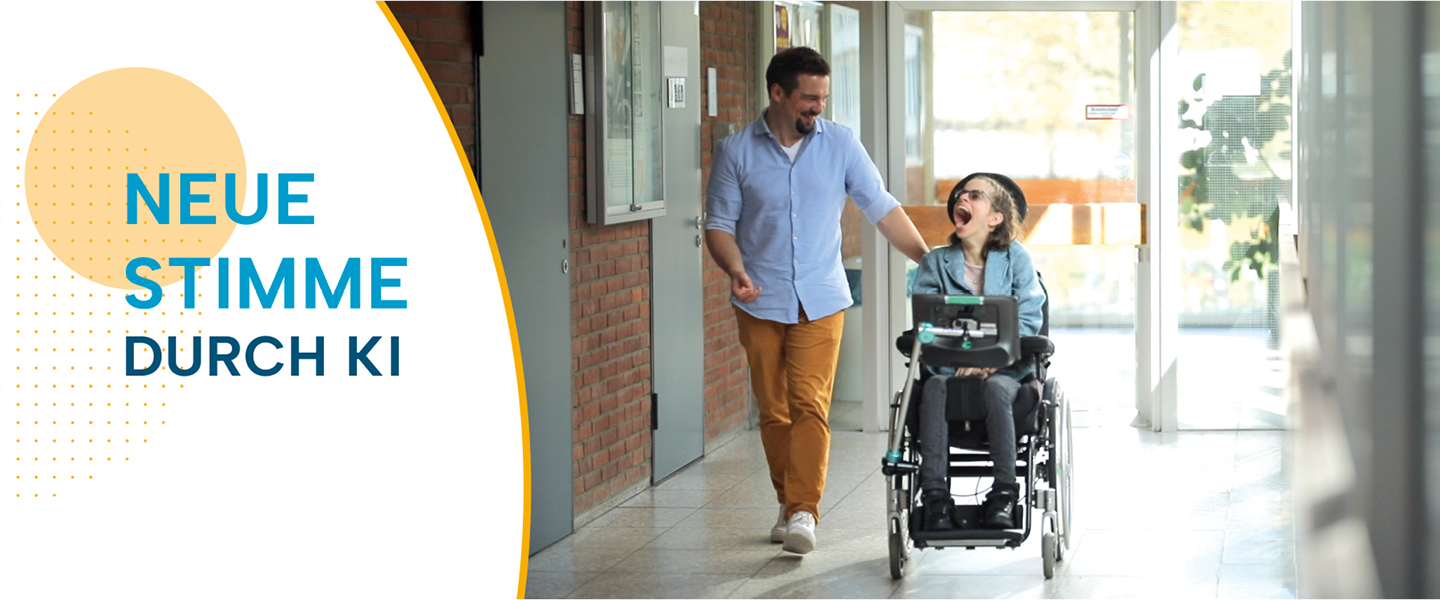
Inclusion Through AI: A New Voice for a Lecturer at the University of Cologne
One’s own voice reveals a lot about personality and character. It gives a sense of identity. But what if one’s own voice is missing?
For Kathrin Klapper (née Lemler), speaking is a calling. The research assistant at the University of Cologne gives presentations at academic conferences, leads seminars for students of therapeutic and special education, and is politically active in promoting the participation of people with impairments and disabilities.
As a research assistant at the University of Cologne, she studies the communicative participation of people with impairments. However, due to her severe physical impairment, Kathrin Klapper is unable to use her own voice to speak—so until now, she has communicated through her speech computer using a monotonous computer voice. Inspired by the voice output of OpenAI’s “Juniper,” Kathrin Klapper set out to find a voice sponsor.
Through a call for volunteers on social media, she found her voice donor, actress Leona Blank. For the actress, participating is a matter of honor: “When I saw the call, it was immediately clear to me: If I can help with my voice, I’ll do it right away.” The project was implemented in no time: “Only 50 recorded sentences are needed to use artificial intelligence to assemble a first version of a new synthetic voice,” explains Jakob Sponholz, who researches digital inclusion for people with disabilities and handled the technical implementation for this project.
Two weeks later, Kathrin Klapper is still completely thrilled: “People around me understand me much better now. Finally, I have a voice I can truly identify with! I’m so grateful to Leona for agreeing to share her voice with me. And the best part is: We sound very similar, but not exactly the same. A bit like sisters—voice sisters, really.”
Kathrin Klapper and Jakob Sponholz hope that in the future, more people who use assisted communication will have the opportunity to speak with their own, individual voice through voice donors.
This project was implemented in the “Education for People with Physical and Motor Developmental Disabilities” department led by Prof. Dr. Jens Boenisch.
A heartfelt thank you goes to the HF Media Network for producing the video documentation of the project, as well as to Tobii Dynavox and the Acapella Group for their technical support.
Contact information for the HF editorial team can be found here.