
dialoguing@rts – Advancing Cultural Literacy for Social Inclusion through Dialogical Arts Education
Objections
The "dialoguing@rts" project addresses profound challenges of social cohesion and inclusion in contemporary Europe and beyond. Trusting in the transformative power of performing arts (music, dance, and theatre), the project explores how cultural literacy acquired through dialogical interactions can counteract prejudice and allow for intercultural dialogue. Not all forms of arts education contribute to social cohesion. Cultural literacy needs dialogic practice, emphasizing the importance of diverse voices in formal and non-formal education. By encountering each other through open dialoguing in the performing arts, individuals practice self-reflection, enhancing how we interact, understand, negotiate, and celebrate the different perspectives people bring to the table.
This appreciation of differing perspectives and experiences is a prerequisite for building intercultural awareness, and a starting point for accepting and celebrating cultural diversity, promoting social cohesion and inclusion. Democratic systems depend on citizens accepting each other in their diversity. In the performing arts, participants can initiate dialogical processes to work towards social inclusion and cohesion.
Work plan
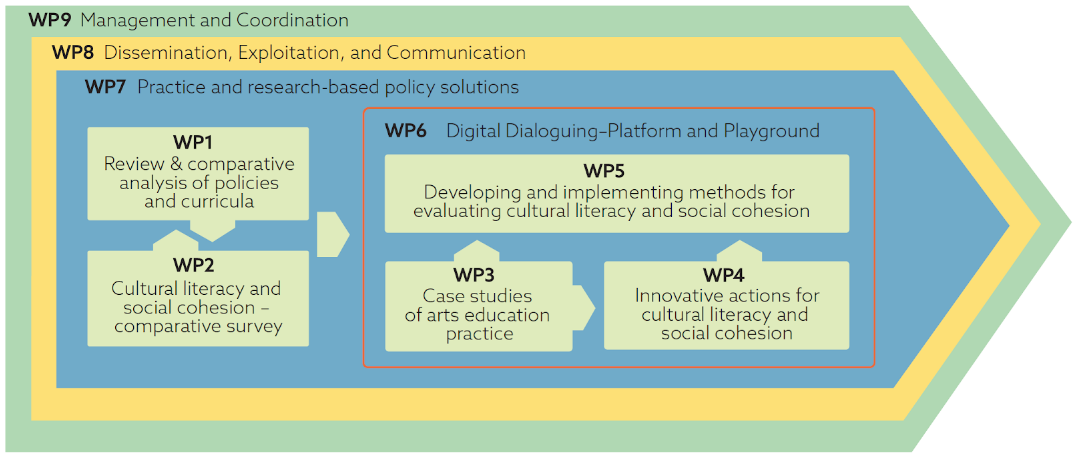
d@rts focuses on five European countries – Norway, Finland, Germany, Italy and Serbia – and two non-European countries – Uganda and Aotearoa/New Zealand. The 42-month long work plan divides d@rts into nine work packages (WPs) that interrelate. WP1–6 conducts the core analytical work using participatory research methods, while WPs 7– 8 focuses on relationships with stakeholders, including ensuring fora for productives exchange, disseminating findings, and implementing them with external partners in the field of arts education. WP9 is responsible for management and coordination.
List of work packages
WP1 Literature review & comparative analysis of cultural and education policies and curricula in Europe
WP2 Cultural literacy and social cohesion – comparative review of European practice
WP3 Ethnographies in dialogue: Case studies on arts education practice
WP4 Innovative actions for cultural literacy and social cohesion (DIALOGART)
WP5 Developing and implementing research methods for evaluating cultural literacy and social cohesion
WP6 Digital Dialoguing-Platform and Playground
WP7 Practice and research-based policy recommendations
WP8 Dissemination, exploitation, and communication
WP9 Management and coordination
dialoguing@arts at University of Cologne
The institute for European Ethnomusicology at the Faculty of Human Sciences, University of Cologne is mainly involved in the following two work packages of the d@rts project.
WP3’s main objective is to examine how performing arts education creates spaces for the promotion of cultural literacy that enhance social inclusion, and to analyze related drivers and constraints. Methodologically, WP3 is framed as multi-sited ethnography, where the ethnographer moves between and within sites. We explore existing performing arts educational practices through fieldwork in diverse cases in European partner countries. The research is carried out by local/regional teams. Participatory and multi-sited ethnographic tools include life-history interviews, semi-structured interviews, group discussions, participant observation, participatory action research, arts-based research, digital storytelling, and audio/video diaries.
WP4 collaboratively develops and executes innovative performing arts education actions for cultural literacy in various target communities. It takes a Community Based Participatory Research (CBPR) approach. This means to engage community members as partners, involving the community in every stage of research.
List of participants
Nord University, Levanger/Norway (coordinator)
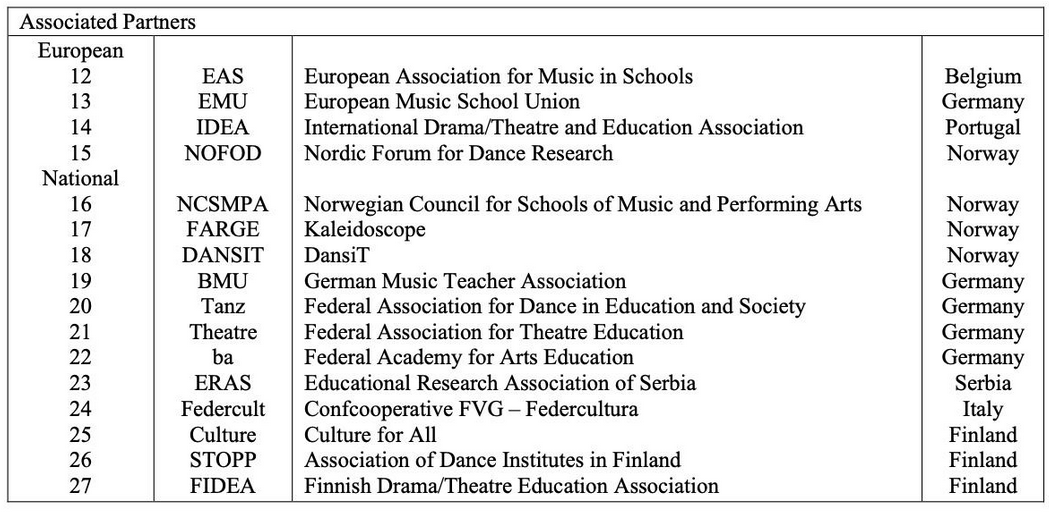
Association Européenne des Conservatoires, Académies de Musique et Musikhochschulen, Brussels/Belgium (AEC)
University of Cologne, Institute for European Ethnomusicology, Germany (UoC)
University of Hildesheim, UNESCO Chair, Germany (UoH)
University of Jyväskylä, Finland
University of Luneburg, Germany
University of Verona, Italy
Puntozero Società Cooperativa, Italy
Kulturanova, Serbia
University of Auckland, UNESCO Chair, New Zealand/Aotearoa
Makerere University, Uganda
Further information under https://cordis.europa.eu/project/id/101132352

Funded by the European Union. Views and opinions expressed are however those of the author(s) only and do not necessarily reflect those of the European Union or the European Education and Culture Executive Agency (EACEA). Neither the European Union nor EACEA can be held responsible for them.