Methods of Education and Social Research with Specific Consideration of Gender Studies / Sociology
Department Educational and Social Sciences

New Publications
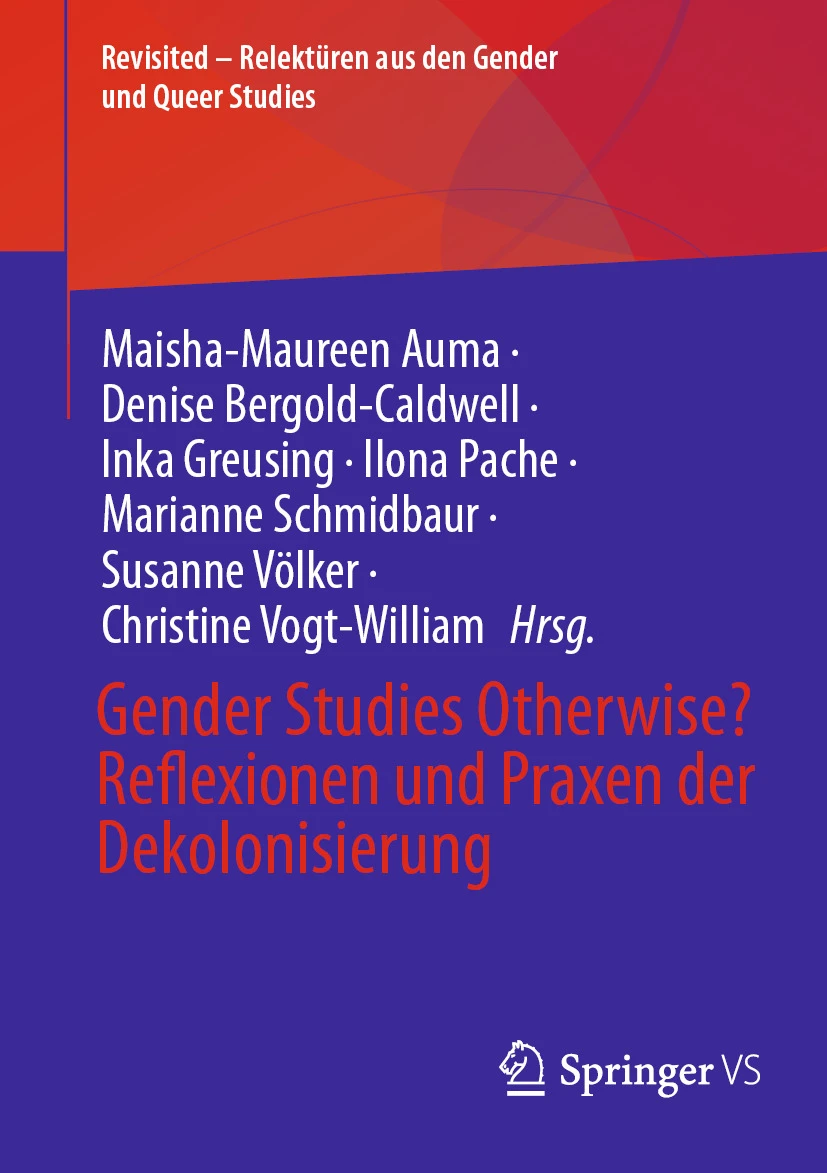
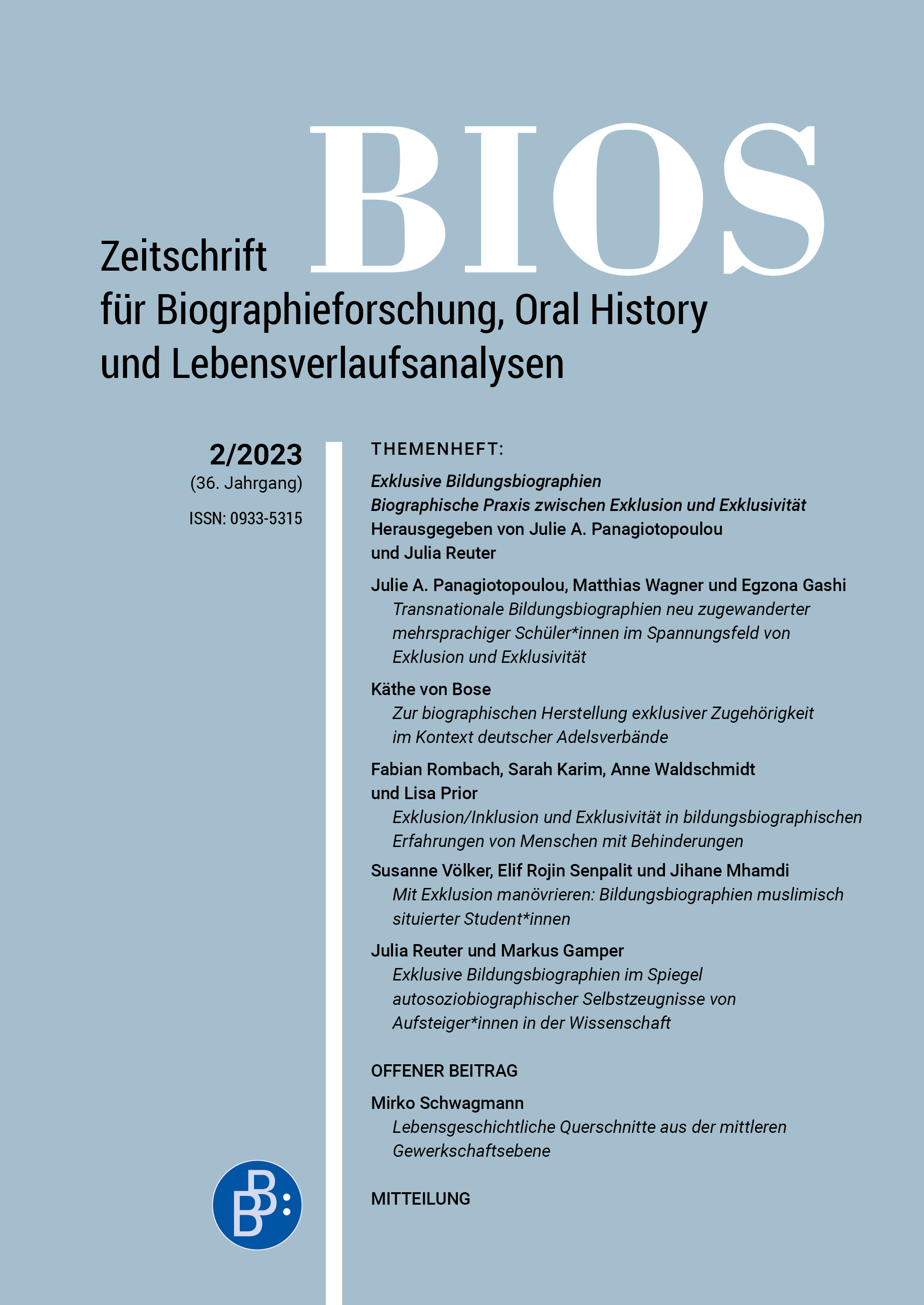
You can find informationen regarding your studies and the supervision of Bachelor's and Master's theses here: https://www.hf.uni-koeln.de/34702
Profile
The main focus of Susanne Völker’s professorship lies on praxeological and deconstructivist sociology and gender studies which take socio-material entanglements and queer-feminist analyses as a starting point. As such, the professorship is centrally organised around issues of ‘gender’ including, for example, symbolic gender orders, institutionalized gender relations, divisions of labour and modes of subjectivation, constructions of identity, sexuality, or the body, understood as categories differentiation, disciplining, and hierarchization. As a critical process gender problematises homogenizing practices and dichotomous juxtapositions that generate inequalities and exclusions, and prevent the recognition of differences as well as equal, fair participation. Here, we approach 'gender' not as an object 'in itself', but as it enters into more or less permanent, coherent or ephemeral, dissonant patterns with other socio-material phenomena.
The professorship's perspective on these patterns builds on Pierre Bourdieu's praxeological sociology. In contrast to theoretical logics of terminological exactitude, a praxeological orientation seeks to reconstruct the conditions for the functioning of practice in the concrete; conditions that are characterised by vagueness, ambiguity, and indeterminacy. With reference to Karen Barad's neo-materialist, transdisciplinary work, however, we move beyond Bourdieu's praxeology to also consider more-than-human relations. We explore situations, conditions, and contingencies in the un/determinacy of practical operations in order to integrate what is sometimes contradictory and mutually exclusive. But if practice is necessarily ambiguous to enable social linkages, then it is not structured by dominant social attributions alone, but has a 'margin' for shifts and ambiguities. Asking ‘How does the new come into the world?’ Homi K. Bhabha not only raises a question of critique, but a methodological question, a question about the practical possibilities for which appropriate methods of social research need to be developed. 'The new' is generated when that which is recognized as 'normal', ‘natural’ or and 'given' is called into question and challenged. Similarly, Judith Butler argues that (painful and often unintentional and unchosen) dis-identifications with ‘normal’ culture, i.e., positions of nonconformity, are crucial for the expansion of what is thinkable as well as democratic debate. Both in terms of epistemology and in the developments of methodologies and methods of social research the professorship, is guided by this deconstructivist-queer and praxeological perspective. In this regard, the content and form of research, teaching, and our approaches to gender equality in the workplace are informed by intersectional perspectives (e.g., Karen Barad's "Onto-Ethico-Epistem-Ontology," Donna Harraway's "Response-ability," Maria Lugone's "Coloniality of gender," Mignolo's "Epistemic Disobedience," etc.).
Our teaching and research engage with processes of change and in contemporary societies, as they become apparent in the increasing precarity of working and living conditions, the overlapping of social inequalities in the educational system, in welfare-state regulations and (milieu)-specific strategies of living. Here, research on today’s post-migrant society as well as queer and/or transnational lifestyles are of particular interest to us (cf. the exploratory studies on educational experiences and opportunities of Muslim students in NRW from 2021 to 2023 by Jihane Mhamdi, Elif Rojin Senpalit and Susanne Völker). Another key area of research and teaching focuses on (more-than-human) relations of care from an inter- and transdisciplinary perspective. Here, we draw on approaches from queer-feminist science and technology studies, queer-feminist new materialism, as well as exploratory qualitative methodological designs (including feminist speculation) that attend also to the agency of nonhuman actors. We consider questions of socio-economic and ecological devastation, climate change and related queer-feminist interventions of the Anthropocene, the decolonisation of gender and queer studies, as well as of knowledge production more broadly, and thus the dialogue of queer and black studies and the advancement of queer theoretical research. Methodologically and theoretically, the professorship's teaching and research activities are strongly influenced by new materialisms and Anthropocene critique in connection with queer and black studies (for example, through the work of bell hooks, Saidiya Hartman, Christina Sharpe).
Contact
University of Cologne
Faculty of Humanities
Department of Educational and Social SciencesMethods of Education and Social Research with Specific Consideration of Gender Studies / Sociology Postal address:Richard-Strauss-Str. 2D-50931 CologneFon: 0221-470-90119Fax: -1275 Visitor address:Aachener Str. 217D-50931 CologneFon: 0221-470-90119Fax: -1275
Staff members
- Univ.-Prof.*in Dr.*in Susanne Völker Professorship Methods of Education and Social Research with Specific Consideration of Gender Studies / Sociology, Room 0B04, Phone: 0221-470-4743
- Dr.in Claudia Nikodem Lecturer (Studienrätin im Hochschuldienst), Room 0B09, Phone: 0221-470-4772
- Dr.*in Thamar Klein Lecturer (Lehrkraft für besondere Aufgaben in der Stellung eines*r Studienrät*in im Hochschuldienst), Room 0B10, Phone: 0221-470-90147
- PD Dr. Ingvill Constanze Ødegaard private lecturer in social sciences, ingvill.constanze.odegaard[at]uni-koeln.de
- Thalea Gundert Research assistant, Room 0B10, Tel: 0221-470-1276
- Asmaa El-Hafsi Lecturer, Room 0B10
- Kathrin Schiller Administration secretary, Room 0B05, Phone: 0221-470-90119
- Lena Wiegers Research assistant, Room 0B09, Phone: 0221-470-4772
- Lisa Haß Research assistant, Room 0A15, Phone: 0221-470-1273
- Paula Piola Fornaçon Student assistant, Room 0B10