
Research Project Roompoint and Systemic Design
With the development of Roompoint, we are exploring the development and optimization of information transfers and visualizations via publicly available so-called "Infoscreens". These are provided with information via various data sources and filters, which are transformed into an optimized design.
With the help of three-dimensional visualizations, even complex information can be experienced.
Aspects of system theory and systemic design play an important role in this project.
If you have any questions about the project or its use, please contact us at the address below.
Phase 1: Infoscreen
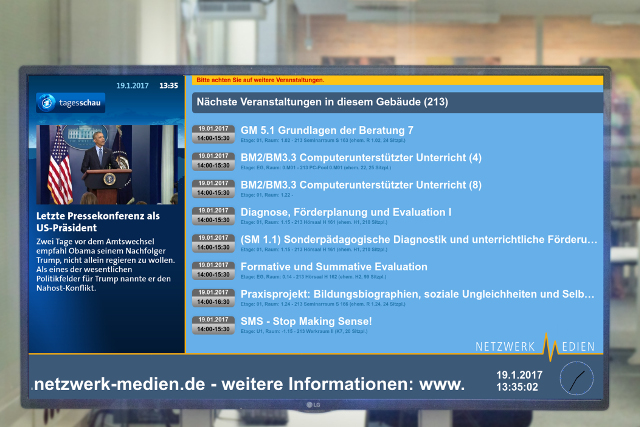
In phase 1, a system was first developed that combines different information channels and aggregates this information. This system combines information in real time from the NDR news channel and the Külner event system KLIPS2 and displays it on so-called Infoscreens, currently in building 213 already in productive use. An expansion of the project for further university buildings is planned.
Components of this research project
Systemic Design: Systemic Design aims at the optimized, complexity-reducing and intelligent visualization of information. Within the framework of the research project we design and investigate designs that are oriented to the principles of systemic design.
KLIPS2 Aggregator: A KLIPS2 Aggregator was programmed for the preparation of event data. For the development of the KLIPS2 aggregator we use the REST interface of the event system CAMPUSONLINE ("KLIPS2"). This REST interface initially delivers all dates to be displayed. A downstream sorter arranges this data according to organizational unit, building and status. A further filter ensures that only the current, next events are made available to the Infoscreen. So that event dates can be easily managed via KLIPS2. The creation, editing or deletion of event dates in KLIPS2 is recognized by the aggregator. The aggregator then automatically updates the respective Infoscreens.
Infoscreen CMS: The data can be supplemented by further appointments and information via an administration system.
Infoscreen-Server: The Infoscreen-Server manages the different data sources and compiles them for single Infoscreens and buildings. Further data, such as weather data, video feeds or news feeds, are added and placed.
Thin-Client: For the supply of up to two Infoscreens a so-called Thin-Client was developed. This thin client is configured in a particularly stable way and functions largely maintenance-free. When the thin client is started or restarted, the info screens are automatically recognized and provided with the appropriate content. Data is updated in real time.
Privacy: Data protection plays an important role in the entire project planning. All data is exclusively processed within the infrastructure of the university. The outsourcing of data to third parties, e.g. in so-called "clouds", is not necessary and does not take place. The processing of event data was checked by the University's data protection officer and approved by the responsible bodies.
We thank the NDR for the kind permission to use the current news and weather data.
Phase 2: 3D visualization with ROOMPOINT
Roompoint is a project for the visualization of room data on info screens. These three-dimensional data are more difficult to transfer on a two-dimensional medium. With Roompoint we explore the visualization of optimized paths via so-called space points, which are visually represented and lead the user to the relevant and important information or places.
Phase 3: Augmented reality based orientation system
The term "Augmented Reality" defines the addition of further information to the experiential world. In concrete terms, the aim is to supplement the real visual image with computer-generated information and models. This information is transferred into reality with the help of three-dimensional models, where it is visible via corresponding mobile devices such as smartphones or tablets.
Project management and development:

Martin Seiler
Wissenschaftlicher Mitarbeiter
Ständiger Vertreter des Leiters Netzwerk Medien
Abteilungsltg. IT/Softwareservices
Ausbilder Fachinformatik (IHK)
Softwareentwicklung
Projektleitung Infoscreens
Informatik in der Lehre
Raum
-1.07
Brieffach
26
Adresse
Frangenheimstr. 4
50931 Köln
Sprechstunde
nach Vereinbarung.