Individual Differences and Psychological Assessment
Individual Differences Action Monitoring - IDAM - Lab
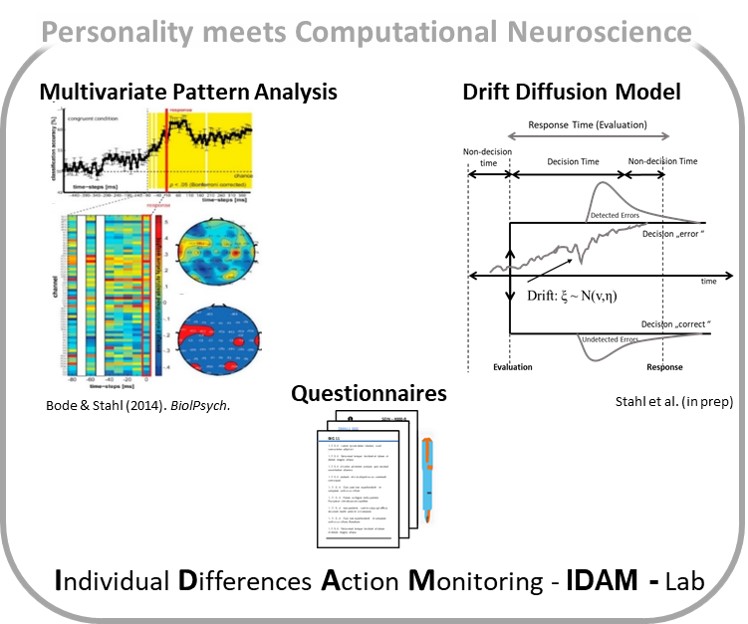
Research Focus I: Personality - Computational Modeling - Neuroscience
To err is human, is a well-known saying. In our lab, we investigate whether error processing works in the same way in each individual? How do (different) people detect errors and respond to different consequences of errors?
We are interested in questions related to human error processing: in general mechanisms of human action control, specific neurophysiological mechanisms of error detection and error correction as well as interindividual differences related to these processes.
To investigate interindividual differences in the involved cognitive processes, we use psychometric procedures (personality questionnaires, performance tests), psychophysical measures (reaction times, reaction force), electrophysiological measures (electroencephalogram, electromyogram), functional magnetic resonance imaging (fMRI) and computational modelling.
Using a multimodal approach, we aimed at investigating the underlying processes, to get a better understanding of the the time course, the location and the type of activity related to error processing.
At first glance, we would expect perfectionism to be a personality trait that, when high, should result in fewer errors and should be accompanied by a very good error detection. However, this is not the case. In addition to some unwanted health consequences, perfectionism can even lead to a poorer error detection (Barke et al, 2017; Stahl et al., 2015). We try to better understand this paradoxical outcome in order to develop methods for people to change these counterproductive strategies.
.jpg) References
References
Barke, A., Bode, S., Dechent, P., Schmidt-Samoa, C., van Heer, C., & Stahl, J. (2017). To Err is (Perfectly) Human: Behavioural and Neural Correlates of Error Processing and Perfectionism. Social cognitive and affective neuroscience. Advance online publication. https://doi.org/10.1093/scan/nsx082
Niessen, E., Fink, G. R., Hoffmann, H. E. M., Weiss, P. H., & Stahl, J. (2017). Error detection across the adult lifespan: Electrophysiological evidence for age-related deficits. NeuroImage, 152, 517–529. https://doi.org/10.1016/j.neuroimage.2017.03.015
Stahl, J., Acharki, M., Kresimon, M., Völler, F., & Gibbons, H. (2015). Perfect error processing: Perfectionism-related variationsin action monitoring and error processing mechanisms. International Journal of Psychophysiology 97(2), 153-162
Bode, S. Sewell, D.K. Lilburn, S. Forte, J.D., Smith, P.L. & Stahl, J. (2012). Predicting Perceptual Decision Biases from Early Brain Activity. The Journal of Neuroscience, 2(36),12488-12498.
Research Focus II: Personality - society - error culture
Errors also play an important role in this research context, but rather from an individual, subjective and social perspective.
Many people have a hard time accepting mistakes as pure information gain, thus, an important part of the learning process. Imperfections are concealed or denied. This not only has individual consequences, but also social and economic consequences and usually slows down any innovative process.
In this research field, error cultures and their determinants and consequences are examined.